LNK Group Moves Five National Networks to Grass Valley AMPP
Lithuanian broadcaster deploys Playout X and Framelight X across five networks, combining on-premises software-defined playout with cloud-based disaster recovery as part of its SMPTE ST 2110 transition.
MONTREAL, CANADA– September 16, 2026 – LNK Group one of Lithuania’s leading commercial television groups has moved playout and media management for its five national television networks to Grass Valley’s AMPP Media Operating System, completing a project to introduce software-defined operations alongside its transition to SMPTE ST 2110.
The deployment covers LNK, BTV, TV1, InfoTV and 2TV, replacing LNK’s legacy playout environment with Playout X and Framelight X running on AMPP Local at its Vilnius facility.
Delivered by Hannu Pro, Grass Valley’s partner in the Baltic region and a certified AMPP Managed Service Partner, the project combines an on-premises primary system with cloud-based disaster recovery.
LNK selected the Grass Valley solution following a competitive tender as part of a wider upgrade of its broadcast infrastructure. The broadcaster required the reliability and operational resilience of national television playout, with greater flexibility to develop services and workflows.
“This project represents an important step in the modernization of LNK Group’s broadcast infrastructure,” said Ričardas Kazlauskas, CTO at LNK Group. “Our objective was to maintain the reliability required for national television broadcasting while giving us more flexibility in how we deploy and develop our services. Moving our five networks to AMPP and Playout X alongside our transition to SMPTE ST 2110 provides that foundation.”
Five Networks on AMPP LNK’s five networks combine scheduled programming, advertising, live content, news and graphics. Redundant Playout X chains provide continuity across all five, with support for live inputs, secondary recordings, HTML5 graphics, advanced audio and SCTE insertion for downstream advertising on LNK’s digital platform. LNK and BTV also support SRT contribution feeds.
AMPP allows applications to run on shared compute rather than dedicated broadcast hardware, giving LNK greater flexibility to introduce or modify workflows. The deployment operates alongside the broadcaster’s SMPTE ST 2110 infrastructure, connecting software-defined applications with its wider IP environment.
“One of the most important aspects of this transformation is that broadcast applications are no longer tightly coupled to dedicated hardware,” said Justinas Kunickas, CIO at LNK Group. “With AMPP we can run applications on shared compute infrastructure, integrate them with our existing systems and introduce or change workflows without rebuilding the underlying signal chain. For us, that architectural flexibility is one of the key benefits of moving toward a Dynamic Media Facility environment.”
Connecting Playout and Media Management Framelight X provides media management, logging, editing, record scheduling and content review, with high-resolution and proxy media held on central NAS storage. It also supports QC and preview of high-resolution content and connects LNK’s active workflows with an archive of approximately 150,000 assets.
Framelight X replaces the archive browsing and selection functionality previously used by traffic, scheduling and promo teams, providing access to content held within the existing Telestream DIVA archive. Hannu Pro integrated DIVA and Vantage with the new environment to meet LNK’s workflow requirements.
For LNK and BTV, disaster recovery is provided through a separate AMPP deployment on AWS, with Wasabi storage for high-resolution and proxy media.
Building on Existing Operations The project continues a technology relationship between LNK and Hannu Pro dating back to 1993. LNK’s wider production environment includes Grass Valley LDX cameras, K-Frame vision mixers and GV STRATUS, alongside Octopus NRCS for news production.
“LNK Group demonstrates how software-defined applications can be introduced into established broadcast operations while maintaining the resilience required for national television,” said Carlos Ferreira, VP of Sales, Southers Europe at Grass Valley. “AMPP gives LNK a common platform for playout and media management across five networks, with the flexibility to run applications on premises and extend critical services into the cloud. Combined with SMPTE ST 2110, it provides a practical route towards the Dynamic Media Facility.”
Kalvis Baumanis, CEO of Hannu Pro, added: “We would like to thank LNK’s management for the trust they have placed in Grass Valley and Hannu Pro while making the bold move into the AMPP Dynamic Media Facility world – among the first broadcasters in the Baltics. With AMPP, LNK’s technical team has hundreds of broadcast tools immediately at hand, covering practically any television production need. Where adding a new capability once meant months of ordering, installing and configuring dedicated equipment, it can now be deployed in minutes.”
####
About Grass Valley
Grass Valley empowers over 90% of the world’s top media brands to create and deliver compelling stories that captivate audiences. At the heart of its solutions is the GV Media Universe (GVMU), combining advanced hardware solutions, with the agility, elasticity, and adaptability of the AMPP Media Operating System. Together, they form a seamless, scalable ecosystem for efficient and innovative workflows.
With a portfolio spanning from camera to consumer, Grass Valley provides the flexibility to build solutions for every need – from a single creative harnessing immense production power to globally distributed teams collaborating seamlessly. This breadth of capability enables customers to craft efficient workflows that inspire and engage their audiences.
With over 65 years of expertise, Grass Valley has consistently driven the evolution of live content creation and storytelling. Headquartered in Montreal and supported by Black Dragon Capital, the company remains dedicated to shaping and leading the media revolution.
Grass Valley Launches AVORA at IBC2026, Bringing All-in-One Live Production to the Show
New standalone solution gives production teams everything they need to create, produce and deliver live content from one flexible system
MONTREAL, CANADA –September 10, 2026 – Grass Valley today announced AVORA, a new standalone, all-in-one live production solution that brings the tools needed to create and deliver sophisticated live shows together in one streamlined system.
Launching at IBC2026, AVORA gives production teams a complete environment to prepare, produce and deliver live content, from switching and graphics to audio, remote guests, content, replay and delivery. Instead of building a production around multiple separate tools, AVORA brings everything together around the show.
At the heart of AVORA is a simple idea: make professional live production easier to create, operate and repeat. Production resources can be prepared, saved, duplicated and recalled as a complete show, making it easy to move between recurring events, formats and productions without rebuilding the workflow each time. Teams can configure the production around the needs of each show and adapt it as those needs change.
“AVORA answers a very clear market need,” said Jonathan Lyth, Product Director for Live Applications at Grass Valley. “Production teams increasingly need professional capability, operational simplicity and the flexibility to scale around the show. AVORA brings the whole live production together in one system, giving teams a simpler way to create, operate and repeat sophisticated live productions.”
AVORA supports both visual, shot-based production and more traditional program/preset operation, allowing operators to work in the way that best suits the production. Its web-based user experience also enables multiple production roles to work with the same AVORA system from their own browser interfaces where required.
Remote guests can join productions through private invitation links, with low-latency connectivity, mix-minus and talkback built directly into the workflow. Content, graphics and prompting are integrated too, while replay, recording, monitoring, playout and delivery extend AVORA beyond production switching into a complete live production environment.
One system. One show. Everything you need.
AVORA is built on the founding principles and technology of GV AMPP, while operating as a standalone Grass Valley solution. It brings Grass Valley’s software-defined production experience into a self-contained all-in-one system, giving teams the flexibility to configure their production without the complexity of assembling and operating multiple independent tools.
AVORA is designed for a wide range of live productions, including sports, live events, venues, education, corporate and enterprise media, regional production and other repeatable workflows. The same system can be configured for different productions, formats and operating models.
For existing AMPP customers, AVORA also provides an additional option for productions where a standalone, all-in-one system is the right operational fit.
AVORA complements Grass Valley’s wider live production portfolio. K-Frame continues to serve dedicated hardware switching environments, while Maverik X and AMPP address software-defined production at enterprise scale. AVORA adds a standalone all-in-one model for productions where integrated capability, flexibility and simplicity are the priority.
AVORA will be showcased at IBC2026 on the Grass Valley booth, stand 9.A01, and in the IBC Future Tech Zone, stand 14.C49, ahead of commercial availability later this year.
#####
About Grass Valley
Grass Valley empowers over 90% of the world’s top media brands to create and deliver compelling stories that captivate audiences. At the heart of its solutions is the GV Media Universe (GVMU), combining advanced hardware solutions, with the agility, elasticity, and adaptability of the AMPP Media Operating System. Together, they form a seamless, scalable ecosystem for efficient and innovative workflows.
With a portfolio spanning from camera to consumer, Grass Valley provides the flexibility to build solutions for every need – from a single creative harnessing immense production power to globally distributed teams collaborating seamlessly. This breadth of capability enables customers to craft efficient workflows that inspire and engage their audiences.
With over 65 years of expertise, Grass Valley has consistently driven the evolution of live content creation and storytelling. Headquartered in Montreal and supported by Black Dragon Capital, the company remains dedicated to shaping and leading the media revolution.
Grass Valley AMPP Provides an All-Encompassing Approach to Advanced Channel Origination
Encompass Digital Media launches Altitude Playout Plus, powered by Grass Valley AMPP, with Channel 4 among two major UK public broadcasters adopting the platform
MONTREAL, CANADA – August 28, 2026 –Encompass Digital Media and Grass Valley are expanding their collaboration with the launch of Altitude Playout Plus, a software-defined channel origination platform developed for broadcasters managing live, late-changing and complex programming.
Encompass Digital Media provides managed media services to broadcasters, networks, sports leagues, federations, and OTT platforms worldwide, supporting channel origination, content processing, live event distribution and delivery.
The new service combines Encompass’s managed services, Media Cloud and Altitude Flow, with Grass Valley AMPP and Playout X, creating an integrated workflow from media supply chain operations through to channel origination and transmission. Channel 4 has selected Altitude Playout Plus to support its channel portfolio under a new multi-year managed playout agreement, with services scheduled to launch in 2027. Channel 4 is the second major UK public broadcaster to select the Encompass and Grass Valley platform, following the successful launch this month.
Altitude Playout Plus has been developed for channels where schedules and content can change close to and during transmission, such as live sports, news and entertainment. Alongside playout, the architecture supports live contribution, event management, recording and fast-turnaround workflows, giving Encompass the flexibility to respond quickly as schedules and content update.
Grass Valley’s AMPP provides the software-defined production and playout foundation, with Playout X supporting channel origination. Encompass integrates these capabilities with Altitude Flow, its media supply chain and control platform, while its web-based Playout Director brings together the operational data needed to manage live programming and late changes.
The result is a distributed architecture that can be deployed across cloud and on-premises infrastructure and operated from multiple Encompass locations. Services for the UK public broadcasters will be delivered from Encompass facilities in London and Riga, providing geographic diversity while giving operational teams flexibility over where resources are deployed.
“Altitude Playout Plus has been designed around the realities of running complex live channels, where schedules can change quickly and operators need immediate access to the services and information required to respond,” said Keir Shepherd, Chief Solutions Officer, Encompass Digital Media. “Our work with Grass Valley gives us a software-defined foundation that we can combine with our media supply chain, operational tools and global managed service capability. Channel 4’s decision to adopt the platform, alongside another major UK public broadcaster, gives us a strong foundation for extending the service to other demanding channel environments.”
The architecture also gives Encompass access to additional AMPP applications when specialist capabilities are required. Resources can be introduced according to the requirements of a channel or event rather than maintained permanently for workflows that may only be used periodically.
For Grass Valley, the deployment demonstrates how its Dynamic Media Facility approach supports established broadcast services across hybrid, geographically distributed infrastructure. AMPP applications can operate alongside existing systems and Encompass technology without requiring the service provider or its customers to standardize operations around a single deployment location.
“Major broadcasters are looking for greater flexibility without compromising the resilience and operational control required for live television,” said Steve Hassan, Senior Director Playout at Grass Valley. “Working with Encompass shows how a Dynamic Media Facility can bring software-defined playout and existing broadcast operations into the same architecture. Resources can be deployed across cloud and on-premises infrastructure and across different locations, giving service providers the flexibility to respond to changing channel and event requirements while maintaining the operational standards their customers expect.”
Extensive design work between Encompass and Grass Valley has been completed ahead of the Channel 4 transition to ensure the platform meets the broadcaster’s technical and operational requirements.
Grass Valley will be at IBC 2026 at the RAI Amsterdam, September 11-14. Visitors can meet the team at Booth 9.A01 to learn more about AMPP, Playout X and the Dynamic Media Facility.
#####
About Grass Valley
Grass Valley empowers over 90% of the world’s top media brands to create and deliver compelling stories that captivate audiences. At the heart of its solutions is the GV Media Universe (GVMU), combining advanced hardware solutions, with the agility, elasticity, and adaptability of the AMPP Media Operating System. Together, they form a seamless, scalable ecosystem for efficient and innovative workflows.
With a portfolio spanning from camera to consumer, Grass Valley provides the flexibility to build solutions for every need – from a single creative harnessing immense production power to globally distributed teams collaborating seamlessly. This breadth of capability enables customers to craft efficient workflows that inspire and engage their audiences.
With over 65 years of expertise, Grass Valley has consistently driven the evolution of live content creation and storytelling. Headquartered in Montreal and supported by Black Dragon Capital, the company remains dedicated to shaping and leading the media revolution.
####
About Encompass Digital Media
Encompass Digital Media is a global managed services company that is technology-driven, software-defined, and people-powered. World-leading broadcasters, networks, sports rights-holders, and OTT platforms rely on its unique global reach, unrivalled quality of service, and unmatched industry expertise to make the most of their media. Every day, Encompass processes over 25,000 hours of content and serves 850 channels to 84 countries; it distributes over 243,000 live events annually, and reaches 400 million radio listeners weekly worldwide.
Encompass’ cloud-first Altitude products – supported by IP distribution, 34,000 miles of fibre, 24/7 NOCs, 50+ satellite platforms, and experienced, passionate people – operate in the sweet spot of high availability and high quality that audiences now demand, enabling content providers to navigate change flexibly and deliver content flawlessly to any audience.
For broadcasters, the value of a content archive depends as much on the metadata attached to each asset as the media itself. Journalists and producers rely on that information to search, identify, and reuse content quickly across fast-moving news workflows.
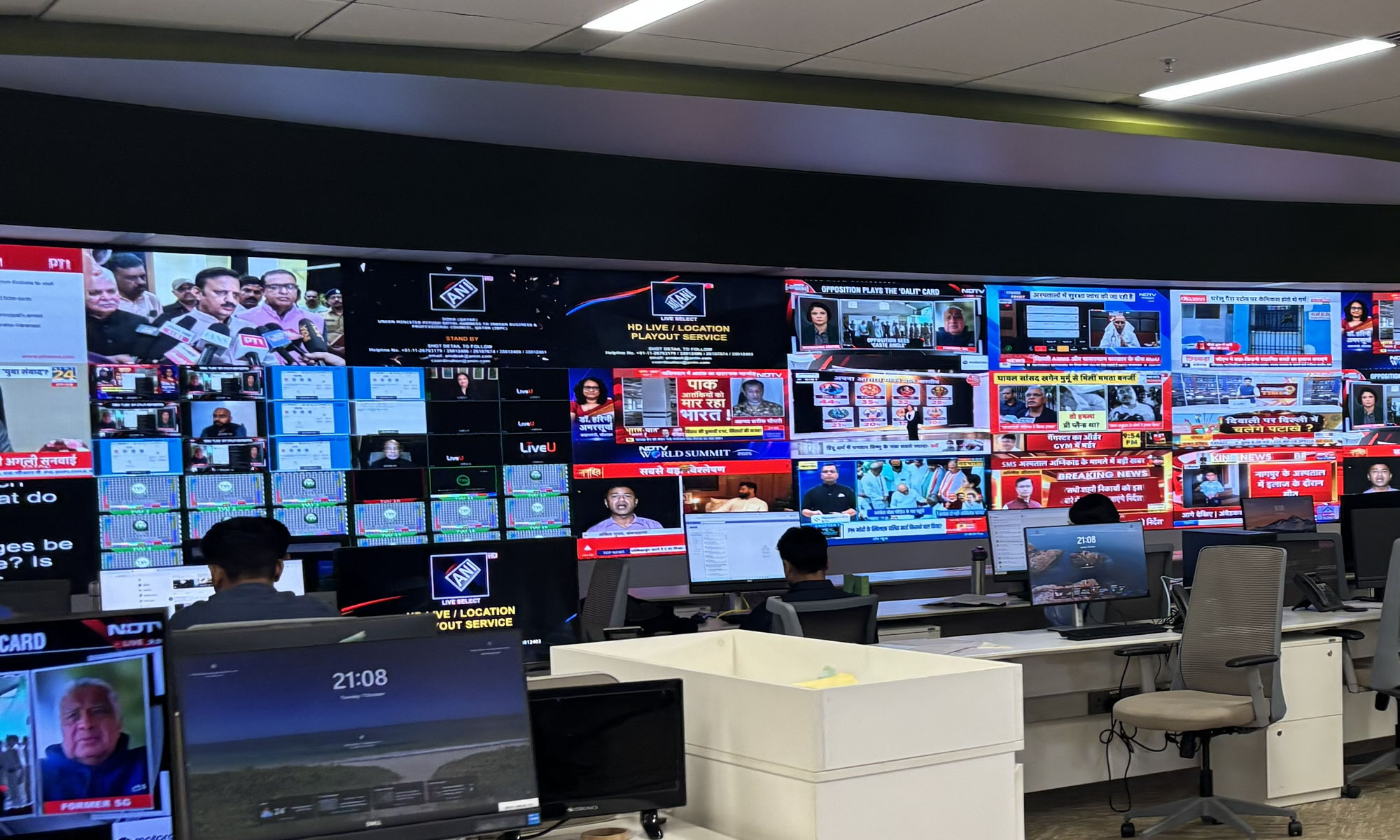
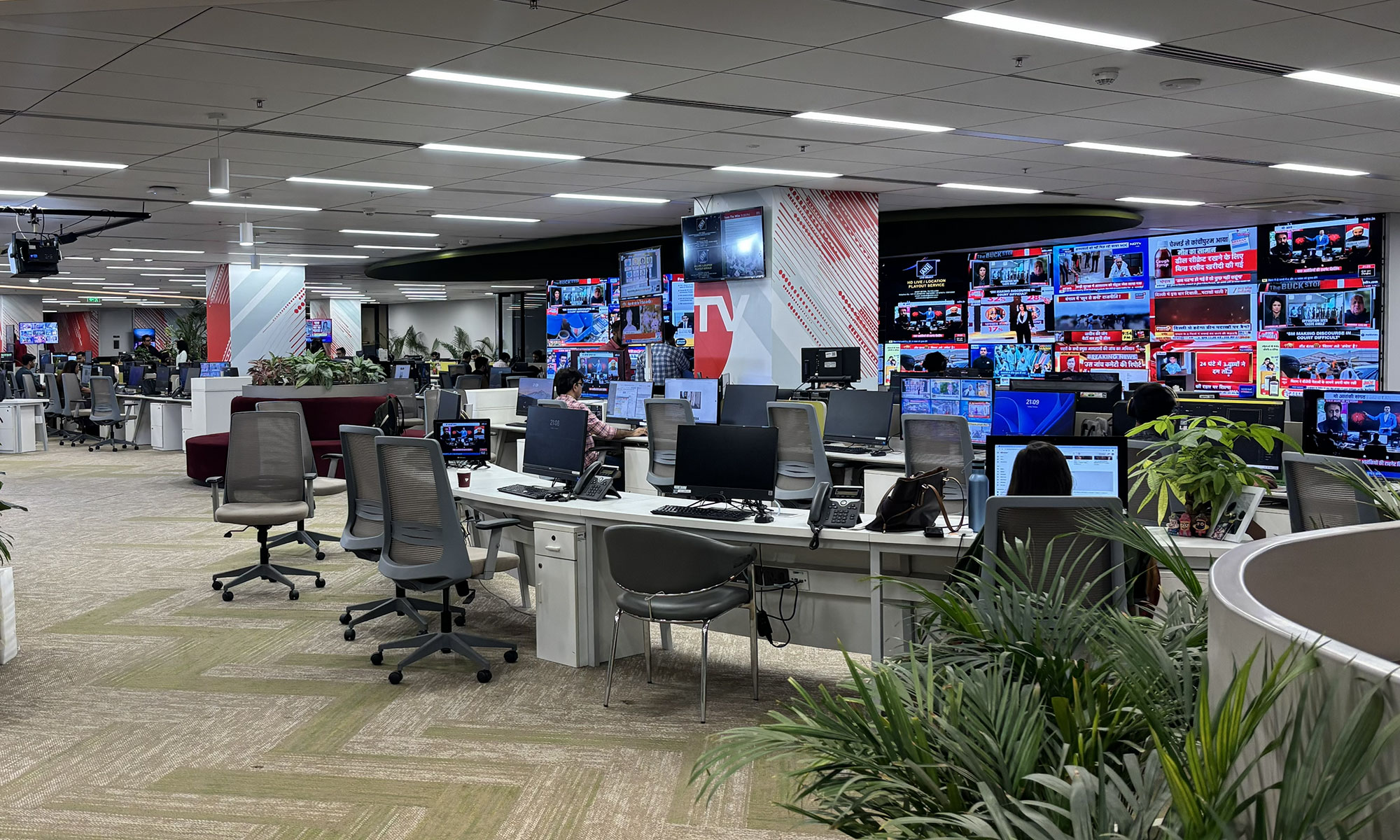
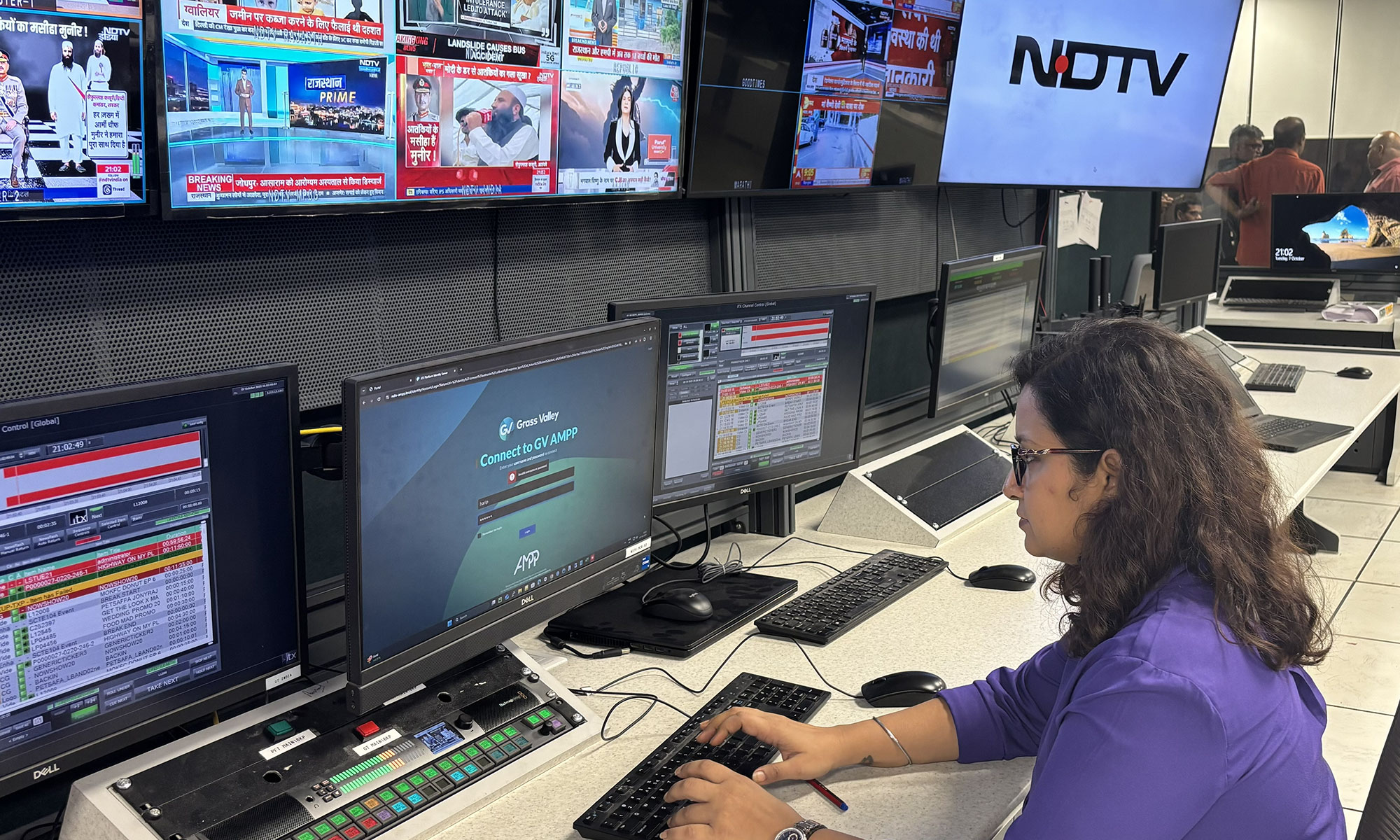
When NDTV set out to modernize its media asset management environment, preserving years of accumulated content and metadata became a key priority. Working with Grass Valley, the broadcaster migrated production and archive content from its existing GV STRATUS environment to the AMPP-powered Framelight X platform while maintaining uninterrupted newsroom operations.
NDTV needed to migrate high-resolution production and archive content from its existing media asset management environment without disrupting day-to-day news production
Alongside the media itself, the broadcaster also needed to preserve the metadata that underpins editorial search, identification, and content reuse
The project required a carefully managed transition that would maintain continuous access for journalists and production teams while creating a more flexible platform capable of supporting future broadcast and digital workflows.
Preserving metadata integrity
We now have a modern MAM environment that supports our current workflows while giving us the flexibility to build on it as our operational requirements continue to evolve.
Dinesh Singh, Chief Technology Officer, NDTV
Solution
Grass Valley migrated NDTV's media assets and metadata from GV STRATUS to the AMPP-powered Framelight X platform using automated workflows, including STRATUS Rules for content export and proxy generation
The system connects ingest, asset management, replay, post-production and playout within a single environment, supported by a microservices architecture that allows components to be updated independently.
Framelight X provides a unified media asset management environment where content and metadata are managed together, allowing editorial teams to search, review, and prepare material through a single interface
Proxy workflows enable users to work efficiently with content while high-resolution media remains securely managed within the platform.
End Result
NDTV now operates from a centralized content management environment that preserves access to both production and archive material while improving collaboration across editorial and production teams. The successful migration maintained workflow continuity throughout the transition and provides a scalable foundation for future workflow automation, archive management, and content production as operational requirements continue to evolve.
Founded in 1988, NDTV is one of India’s leading news broadcasters, delivering television and digital news services to audiences across India and international markets. The company operates multiple news platforms supporting fast-paced editorial workflows, where rapid access to media assets and metadata is essential for daily news production. Through its long-standing partnership with Grass Valley, NDTV continues to invest in modern, scalable production technologies that support both current operations and future workflow development.
Grass Valley Enables Sky News Australia’s Cloud-First Newsroom Transformation with AMPP
Browser-based editing, remote production, and scalable playout power 24/7 multi-platform news delivery
MONTREAL, CANADA – June 2, 2026 –Grass Valley today announced that Australian News Channel (ANC), operator of Sky News Australia, has deployed Grass Valley AMPP to transform its newsroom production operations as part of the relocation of its national headquarters.
The transition replaces a long-standing legacy system with a cloud-based production architecture, enabling more than 250 journalists, editors, and producers to collaborate through browser-based workflows. The platform now supports the delivery of over 1,500 hours of content each week across broadcast and digital platforms.
“This transformation has fundamentally changed how we operate as a newsroom,” said Jesse Hicks, Deputy Head of Operations and Innovation, Sky News Australia. “Our teams can access editing tools from anywhere, collaborate in real time, and turn around content faster without compromising quality. It gives us the flexibility needed for modern news production while maintaining the reliability required for a 24/7 environment.”
ANC deployed the AMPP ecosystem, as part of a relocation project replacing an SQ based news production system from Grass Valley’s Quantel lineage. The solution includes Framelight X for browser-based editing, Playout X for cloud playout, and integrated asset management, ingest, and storage services. Journalists can now create and edit content directly in a web browser, removing reliance on physical workstations and accelerating production workflows.
The new workflow supports fully distributed production, enabling teams to work across the newsroom, field locations, and remote environments. By streamlining processes and reducing manual tasks, ANC has improved efficiency and redirected time toward content creation.
“Undertaking a full newsroom transformation alongside a headquarters relocation is a complex challenge,” said Jon Wilson, CEO, Grass Valley. “ANC took a clear, strategic approach – moving to an integrated software defined model that delivers greater flexibility, scalability, and resilience across its operations. This project reflects our long-standing partnership and a shared commitment to modernizing news operations live production.”
Since going live in November 2025, the platform has delivered continuous 24/7 operation without downtime, demonstrating the reliability of cloud-based production at scale. As an early adopter of AMPP for newsroom workflows, ANC continues to work closely with Grass Valley, providing operational feedback that informs ongoing platform development.
#####
About Grass Valley
Grass Valley empowers over 90% of the world’s top media brands to create and deliver compelling stories that captivate audiences. At the heart of its solutions is the GV Media Universe (GVMU), combining advanced hardware solutions, with the agility, elasticity, and adaptability of the AMPP Media Operating System. Together, they form a seamless, scalable ecosystem for efficient and innovative workflows.
With a portfolio spanning from camera to consumer, Grass Valley provides the flexibility to build solutions for every need – from a single creative harnessing immense production power to globally distributed teams collaborating seamlessly. This breadth of capability enables customers to craft efficient workflows that inspire and engage their audiences.
With over 65 years of expertise, Grass Valley has consistently driven the evolution of live content creation and storytelling. Headquartered in Montreal and supported by Black Dragon Capital, the company remains dedicated to shaping and leading the media revolution.
Warner Bros. Discovery’s coverage of the Olympic Winter Games Milano Cortina 2026 formed part of a broader transition towards a unified production platform designed to support both large-scale live events and continuous sports output.
Built on Grass Valley’s AMPP and underpinned by Framelight X and Playout X, the platform connects editorial, engineering and operations teams across multiple locations. It provides a shared production environment capable of scaling to meet the demands of Olympic coverage while continuing to support Eurosport and TNT Sports programming. The approach reflects an ongoing shift towards software-defined, distributed production workflows across Warner Bros. Discovery’s sports operations.
The Winter Olympics takes place alongside a full international sports calendar, requiring Warner Bros. Discovery to manage Olympic coverage while maintaining its regular output.
This increases pressure on ingest, content management and playout workflows, particularly when handling hundreds of live feeds, multiple editorial teams and frequent schedule changes due to weather delays
Previous workflows, built around individual events or locations, introduced operational complexity and duplication.
The challenge was to create a single production environment capable of scaling to Olympic-level demand while remaining flexible enough to support day-to-day sports production, without requiring separate infrastructure builds or disrupting live operations during system updates or expansion.
600+ Daily Users at Peak
During the Milano Cortina Games we saw an average of more than 600 users per day across Europe and the US and around 680 concurrent users working on the platform at peak.
Warner Bros. Discovery deployed a unified platform based on Grass Valley AMPP, with Framelight X acting as the workflow engine and Playout X managing channel delivery.
The system connects ingest, asset management, replay, post-production and playout within a single environment, supported by a microservices architecture that allows components to be updated independently.
Ingest workflows were modernized through a migration to MXF and Elastic Record X, enabling scalable recording across distributed infrastructure.
Custom interfaces within Playout X, including a dedicated Sports UI, were developed to support live operations, while Framelight X improvements enhanced content search and accessibility across multiple teams and locations.
End Result
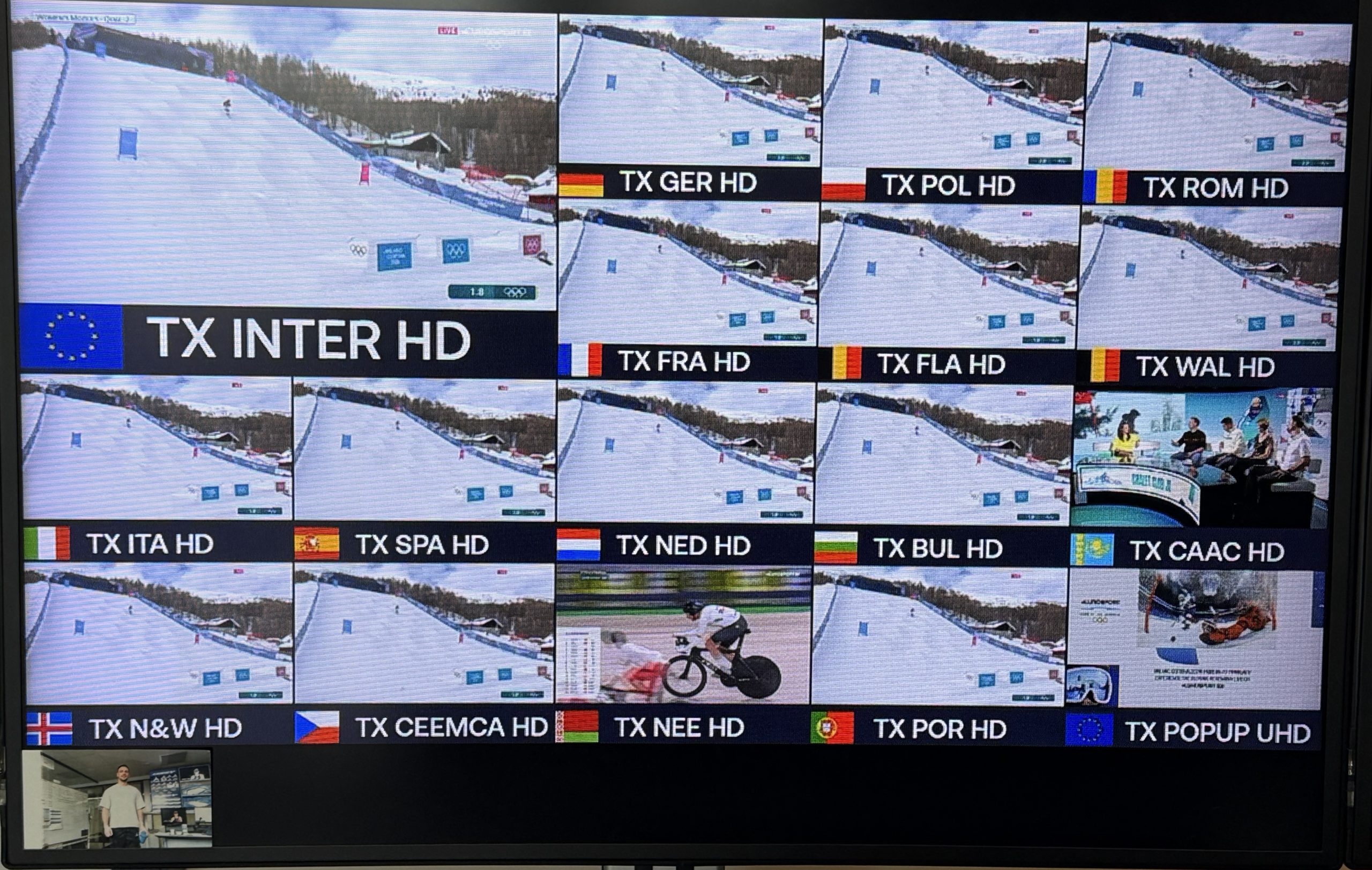
During Milano Cortina, the platform supported more than 600 daily users, peaking at around 650 concurrent users across Europe and the US. It handled over 62,000 hours of recorded content and more than 4,000 recording tasks in a single day, while delivering 42 linear channels in 22 languages alongside more than 100 digital channels. Content was accessible across workflows during ingest, reducing delays between capture and publication. The platform enabled the launch of additional pop-up channels and supported distributed production across Paris and London, maintaining operational continuity while allowing teams to scale output efficiently across both Olympic and regular sports coverage.
Warner Bros. Discovery is a global media and entertainment company operating a portfolio of television networks, streaming services and production businesses. Its sports division delivers live coverage across major international events, including the Olympic Games, alongside year-round programming through brands such as Eurosport and TNT Sports. The company continues to invest in software-defined and distributed production models to support evolving audience demands and operational requirements. By standardizing workflows across a unified platform, Warner Bros. Discovery is developing a scalable production environment capable of supporting both large-scale live events and continuous content delivery across multiple markets and platforms.
Building a Platform for Olympic-Scale Sports Production
Delivering Olympic coverage across Europe requires production teams to manage hundreds of feeds, multiple editorial teams and simultaneous live events. For Warner Bros. Discovery, the Olympic Winter Games Milano Cortina 2026 provided another opportunity to operate and refine a production platform, driven by Grass Valley’s AMPP using Framelight X and Playout X, designed to support that scale.
Milano Cortina was my seventh Olympics working with Eurosport and Warner Bros. Discovery. Each Games brings different operational challenges, but this one highlighted how much our production infrastructure has evolved in recent years.
Over several Olympic cycles we have moved towards a shared production platform connecting editorial teams, operators and engineers across our operations. The aim has been to support both major live events and day-to-day sports production through the same infrastructure.
Earlier Olympic workflows were organised differently. Production environments were often built around individual events or teams, which meant systems and capacity were spread across multiple locations. Over time, we moved towards a unified platform – built on Grass Valley’s AMPP and underpinned by Framelight X and Playout X – that was capable of supporting Olympic coverage alongside our regular sports output, as well as adding capacity for new channels and capabilities.
Today, through Grass Valley’s Framelight X, teams can access the same production environment from multiple locations. During the Milano Cortina Games we saw around 650 concurrent users working on the platform at peak, with an average of more than 600 users per day across Europe and the US.
Supporting that level of collaboration requires infrastructure that can evolve without interrupting live production. The core platform powered by Grass Valley’s AMPP operates on a microservices architecture, with the Framelight X workflow engine connecting ingest, content management, central LiveTouch replay management, playout (Playout X) as well as post production. This allowed engineers to update individual components without affecting the wider system.
In the past, system upgrades were often lengthy processes requiring updates to each individual user’s computer, but changes can now be introduced gradually while production continues. With the GV team, we reconfigured the core AMPP platform through software-defined production for the event instead of rebuilding it as a one-off workflow. This also changed how we introduced new services, by extending existing resources rather than deploying new infrastructure.
During Milano Cortina, this approach supported the launch of additional pop-up channels alongside our core services.
Central to all of this was the Framelight X story-centric, continuous media production environment, which is specifically designed for high-demand and distributed operations like ours. Framelight X federated all of our content into a single system, giving us streamlined access to everything we needed – from ingest through to editing and publishing – from any location.
Scaling ingest and managing content
One of our priorities ahead of Milano Cortina was ensuring the platform could handle the volume of content we expected to record. Unlike a summer Olympics where most other major competitions are no longer running, the Winter Games sit right in the middle of an extremely busy global sports calendar. So in addition to our Winter Olympics coverage, we were also delivering our regular sports output across Eurosport and TNT Sports, which meant managing multiple events simultaneously. That complexity is added to by the Winter Games being more susceptible to weather delays and last minute rescheduling, as we experienced this year with events being postponed by snow delays.
Across the Games, the platform handled more than 62,000 hours of recorded content, with peaks of over 4,000 recording tasks in a single day.
Working with Grass Valley, we completed a migration project that modernised our ingest workflow and expanded recording capacity, moving us away from legacy GV I/O recording workflows using CMF formats and towards an architecture based on MXF and Elastic Record X.
With this model, the ingest layer remains local while the resources required to run the recording services and connect to Framelight X can scale through distributed infrastructure. At the same time, the platform operates as a single production environment, with media asset management, playout, production tools and post-production capabilities all connected to the same core storage. Content doesn’t need to be moved between systems, and is accessible from any tool, even during ingest, across 22 supported languages.
This simplifies operations and support, while ensuring content is immediately available to editorial teams. It also reduces duplication across systems and helps teams deliver more content, more efficiently. This allowed us to add 80 additional recording ports to cope with the recording peaks during the Games.
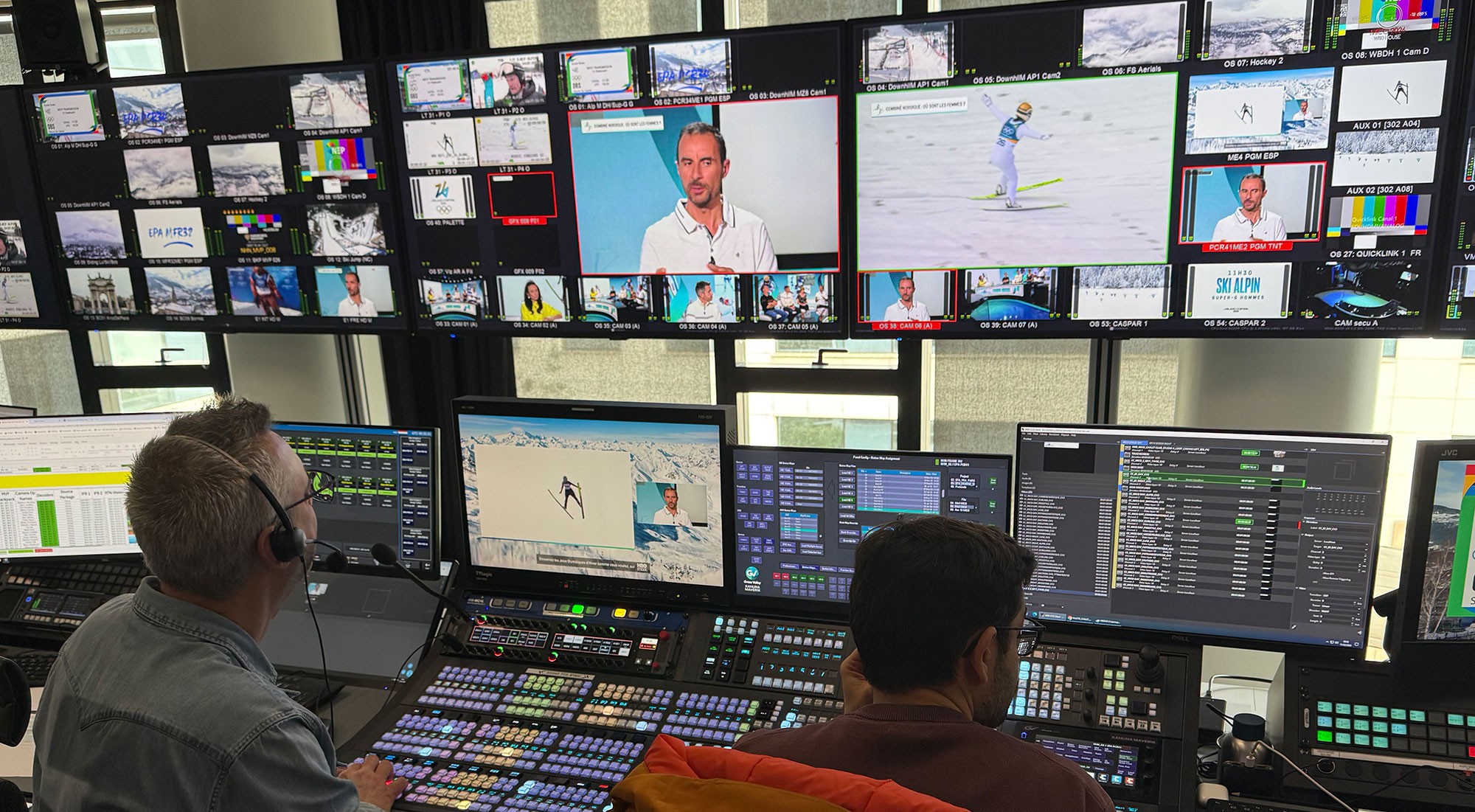
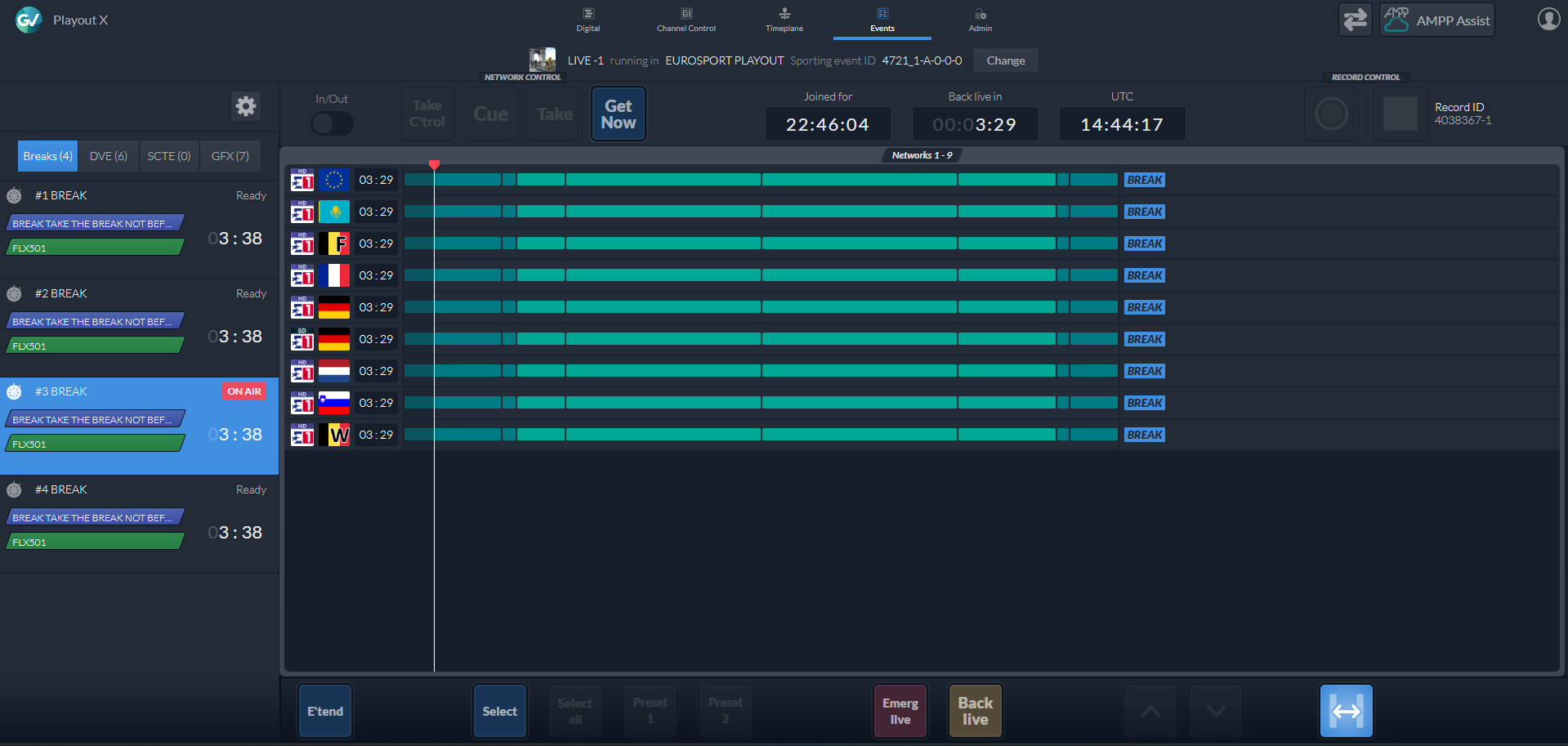
Alongside ingest, we also identified specific requirements around playout and commercial break handling. Working with Grass Valley, we developed dedicated user interfaces within Playout X to support live operations and simplify how commercial breaks are managed. One of these is the Sports UI, which allows operators in the PCR gallery to manage commercial breaks directly during live production, without needing to be connected to the central playout system. This gives production teams more flexibility during live events while allowing central teams to remain focused on international and master playlists.
We also extended our approach to regionalization. Alongside a primary international feed, we operate multiple regional channels that can either follow the main feed and replace breaks with local content, or opt out entirely to deliver rights-specific programming. This allows us to maintain a single master playlist while supporting multiple localised outputs in a more efficient and scalable way.
At the same time we reviewed how operators interacted with the platform itself. Following the Paris 2024 Games, feedback from users highlighted the difficulty of locating specific clips within large volumes of recorded content.
When hundreds of feeds are recorded simultaneously, search and discovery become critical parts of the workflow. Together with Grass Valley we focused on improving Framelight X’s search capabilities and metadata handling within the system, and during Milano Cortina the difference was noticeable. Operators were able to locate relevant material much faster, which helped editorial teams publish content more efficiently across both digital and linear platforms.
Resilience and distributed production
Operational resilience is another essential requirement for large-scale live production. For the Winter Games, Paris and London served as our main operations centres for Olympic coverage. The system is designed so that either location can assume control if required; for instance, if an operational issue occurred in Paris, our teams in London could immediately manage recording operations through the same scheduling interface. And vice versa.
Rather than relying on disaster recovery processes that activate only during emergencies, the platform operates in a balanced mode where redundancy is already built into day-to-day operations.
The same infrastructure also supports more distributed production models. Across the Games, we delivered 42 linear channels in 22 languages, alongside more than 100 digital channels, supporting over 4,000 live events across linear and digital platforms.
For some workflows it is no longer necessary to move large numbers of people or equipment to every event location. Infrastructure can remain in central data centres, cloud environments or any hybrid, while production teams connect remotely. For the Milano Cortina Games, I was based in Paris rather than being on site in Italy. From a production perspective this approach allows us to coordinate resources more efficiently across multiple events.
Collaboration and continuous improvement
Technology provides the framework for these workflows, but large productions ultimately depend on the teams operating them. Our engineering and operations groups are stationed in Paris, London, the US and across Europe with each region handling its own dedicated editorial requirements, and collaboration between those teams is essential during major events.
Engineers also need to think from the perspective of operators and editorial teams. A workflow that appears simple from a technical point of view may become inefficient if it needs to be repeated many times during a production day. Feedback from operators after each major event helps guide improvements ahead of the next production cycle.
Looking ahead, our focus now moves to upcoming productions such as [the French Open Tennis Championship at] Roland Garros, while we continue to evolve the platform itself. One area we are exploring is the increased use of 1080p HDR as a mezzanine format for production workflows. We are also building additional media platforms for other parts of the Warner Bros. Discovery portfolio, including free-to-air channels in Nordic markets.
Each event adds experience that feeds into the next stage of development, and the AMPP-powered platform – driven by the innovative capabilities of the Framelight X and Playout X systems – continues to evolve alongside the production requirements it supports.
Grass Valley Launches Future Playmakers Program to Support the Next Generation of Sports Production Talent
New initiative combines scholarships, hands-on learning, and access to Grass Valley technology to help universities develop industry-ready talent for live sports production
MONTREAL, CANADA – April 6, 2026 – Grass Valley today announced the launch of its Future Playmakers Program, a new global initiative designed to support and develop the next generation of professionals in sports production and media technology.
Timed ahead of NAB Show, the program reflects Grass Valley’s continued investment in education, workforce development, and long-term industry growth. It is built to help students gain practical experience while enabling higher education institutions to strengthen their production programs with access to professional-grade tools and workflows.
The Future Playmakers Program combines scholarships, hands-on learning, technology access, and institutional collaboration. It is designed to create a sustainable pipeline of talent trained on industry-standard solutions used across live sports and event production.
“Developing the next generation of talent is critical to the future of our industry,” said Jon Wilson, CEO of Grass Valley. “The Future Playmakers Program is about giving students real access to the tools, workflows, and experiences that define modern live production, while strengthening our partnerships with the institutions shaping that future workforce.”
Through the program, Grass Valley will select up to 10 students annually from participating partner institutions. Selected students will receive financial support alongside access to experiential learning opportunities designed to bridge the gap between academic study and real-world production environments.
A central component of the program is the Grass Valley Montreal Technology Experience, where students will engage directly with the company’s technology and teams. The experience includes a factory tour, hands-on product demonstrations across cameras, production switchers, AMPP, and orchestration solutions, as well as live production workflow sessions and access to industry experts.
“The industry is evolving quickly, and there is a clear need for talent that understands both production and technology,” said Greg Doggett, Vice President of Sales, NAM Sports, Grass Valley. “This program is designed to give students that exposure early, while helping higher education institutions build programs that reflect how live production operates today and gaining important exposure to where the industry is headed.”
Participating institutions benefit from scholarship opportunities, increased industry visibility, and closer collaboration with Grass Valley through technology alignment and program engagement. The initiative is open to higher education institutions and production programs investing in next-generation broadcast and live production workflows.
By connecting students, educators, and industry professionals, the Future Playmakers Program aims to deliver long-term value across the media ecosystem. It supports the development of operators, engineers, and production specialists equipped to work in increasingly complex, IP-based, and software-defined environments.
Grass Valley will share additional updates on participating institutions as the program expands.
#####
About Grass Valley
Grass Valley empowers over 90% of the world’s top media brands to create and deliver compelling stories that captivate audiences. At the heart of its solutions is the GV Media Universe (GVMU), combining advanced hardware solutions, with the agility, elasticity, and adaptability of the AMPP Media Operating System. Together, they form a seamless, scalable ecosystem for efficient and innovative workflows.
With a portfolio spanning from camera to consumer, Grass Valley provides the flexibility to build solutions for every need – from a single creative harnessing immense production power to globally distributed teams collaborating seamlessly. This breadth of capability enables customers to craft efficient workflows that inspire and engage their audiences.
With over 65 years of expertise, Grass Valley has consistently driven the evolution of live content creation and storytelling. Headquartered in Montreal and supported by Black Dragon Capital, the company remains dedicated to shaping and leading the media revolution.
Playout at the Center of Multi-Platform Channel Delivery
If you spend time in master control, you know most issues are not major failures. They are small misalignments. A timing difference. A late change that doesn’t carry across. Something that looks minor but ends up on air.
Playout is where those things are either managed or exposed.
What has changed is the environment around it. Broadcasters are no longer delivering a single output. The same channel is now delivered across linear, OTT, FAST and web, often at the same time. The expectation is that everything stays aligned.
That shift is what is driving changes in how playout is managed.
Network18 in India is a clear example. Operating more than 25 television channels alongside a growing digital presence, the goal was to consolidate broadcast and digital workflows into a single system. By deploying Playout X on AMPP, their linear, OTT, and web services are now managed through one platform.
Before that, like many broadcasters, they relied on multiple vendors and separate systems. Moving to a unified, integrated approach simplified operations and reduced complexity across broadcast and digital workflows.
A similar shift can be seen with Sky Network Television. As part of a broader modernization of its playout operations, Sky is deploying Playout X on AMPP across 10 HD channels. The deployment introduces UHD support and a flexible, cloud-ready environment that can operate across on-premises, hybrid, and cloud-burst models, while integrating with existing systems.
A related change is visible in how resilience is being approached. It is no longer treated as something separate from the main operation.
Asharq News took a different approach, implementing a cloud-based disaster recovery solution on AMPP using Playout X and Framelight X. Delivered as a fully hosted SaaS deployment, the system allows them to maintain continuity without reliance on dedicated on-premises infrastructure.
What stands out in that approach is that recovery is not isolated. It is part of the overall workflow, supporting both live and on-demand content delivery while maintaining operational continuity across platforms.
Across these examples, the pattern is consistent.
Broadcasters are moving away from fragmented systems toward a single environment that can handle multiple outputs at once. That includes playout, ingest, recording, ad workflows, and OTT and FAST delivery operating as part of the same system rather than separate chains.
The benefit is not just technical. It reduces the amount of coordination required between systems and teams. Operators have a clearer view of what is on air, and changes can be applied consistently across all outputs.
That is what keeps channels aligned.
Playout remains the final control point before content reaches the viewer. That has not changed. What has changed is the number of outputs that need to stay synchronized at the same time.
The role of playout is no longer just to keep a channel on air. It is to keep every version of that channel aligned, consistent, and reliable across all platforms.
Reflections on ISE 2026
Last year, Grass Valley made its ISE Show debut and approached it very deliberately as a listening exercise. You learn quickly how teams are building within real constraints, as well as the pressures they are working around and what they expect and need from the systems that support them.
12 months later, returning to Barcelona really confirmed how broadcast, AV, enterprise IT and live production are now overlapping and informing the same projects. That overlap was visible in the kinds of environments people described throughout the week. Corporate studios producing weekly output as part of internal operations, government spaces designed for permanent capture, archive and oversight, venue control rooms supporting both in-room and distributed audiences as standard.
Convergence is now expected in the design
As video becomes more embedded, the questions teams bring to the table change. Teams want workflows they can return to without rebuilding from scratch, and they want to know that when expectations change, the system will move at the same pace. Most organizations discover over time that requirements are rarely fixed and what looks sufficient during installation can feel restrictive a year later.
Enterprise environments bring additional layers of responsibility. Governance frameworks are often in place before production technology is introduced, while security review is routine. In finance environments, policy dictates where media can exist and how it can move, while in government settings, continuity and oversight are seen as core expectations.
Software-defined production has gained attention in that context because it allows a separation in the way the architecture is structured. With AMPP, media processing can remain within the customer’s controlled environment when required, while orchestration and workflow management operate independently. That flexibility provides room to adapt over time and it means teams can reconfigure workflows without dismantling the entire deployment.
When permanence changes the conversation
Another key observation from the show was the longevity of enterprise installations. They are environments expected to remain operational in the long-term and integrators play a key role because they understand how production fits into the building, the network or the governance model. Their perspective often determines whether a system becomes part of the organization’s standard operating approach.
Whether it’s integration surfaces, APIs, long-term supportability or the ability to connect production into a broader system, they are all part of what determines whether a platform can be standardized over time. These considerations influence long-term viability more than a single product specification. Channel enablement, therefore, is directly tied to product relevance. If partners cannot extend and adapt the platform confidently, then the system’s lifespan shortens.
Developing for real-world lifecycles
Looking at the upcoming roadmap, several themes are emerging. IPMX support is planned for later in 2026, building on the existing ST 2110 foundations. Interoperability continues to shape deployment decisions, particularly in environments where infrastructure must coexist with broader network strategies. Product development is also moving through steady iteration, with feature additions increasingly shaped by customer feedback from deployed environments.
But while 2026 priorities are concentrated in corporate, finance, government, and venue markets, it was interesting to see how other sectors, including esports, education, house of worship and health are already active and likely to become more structured areas of attention. The ambition for enterprise media is straightforward, building a revenue base that can grow and sit alongside broadcast over time, a reflection of just how deeply embedded video has become, especially in organizations that would not have described themselves as media operations even a few years ago.
What ISE reveals about where this is all heading
ISE 2026 reinforced that convergence between broadcast AV and enterprise media is now influencing everything from system design through to integration and procurement. Teams are approaching video as infrastructure, with longevity and adaptability now part of the evaluation criteria from the outset. For Grass Valley, it simply reinforces the direction we are already focused on. We are here to support teams with platforms and partner ecosystems that fit this enterprise reality, where convergence shapes how systems are expected to operate and evolve over time.